How High-Traffic Retail Locations Support Indoor Mobile Offload
Case Studies
Dec 15, 2025
A Kansas City Case Study
Indoor mobile connectivity has become a growing challenge for carriers—especially in busy retail environments where customers constantly enter, wait briefly, and leave. To address this, carriers increasingly rely on indoor offload: shifting mobile data traffic onto neutral-host infrastructure inside businesses.
This case study looks at how one high-traffic retail location in Kansas City performed over three months—and what other small businesses can learn from it.
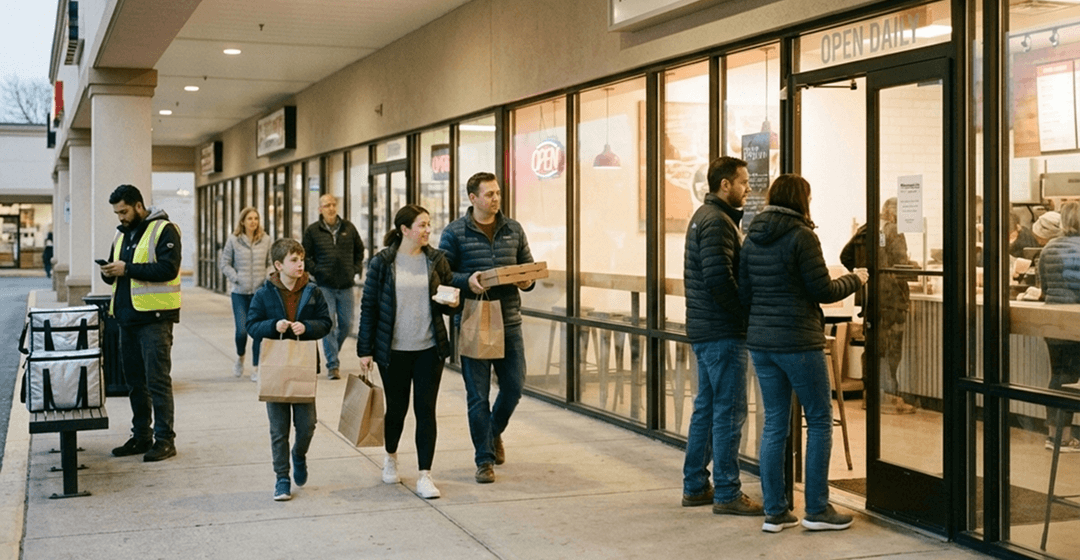
The Location: A High-Traffic Strip-Mall Pizza Shop
The site featured in this case study is a Little Caesars location in Kansas City, KS, located within a multi-tenant strip mall.
This type of environment is common across the U.S. and shares a few important characteristics:
Consistent daily foot traffic
Short customer visits (order, wait, leave)
Delivery drivers and walk-ins throughout the day
Nearby businesses contributing additional activity
These conditions make strip-mall restaurants a strong fit for indoor mobile offload, where frequent short visits create repeated connection opportunities.
What Was Deployed (Clear Timeline)
To ensure clarity, here’s how the deployment evolved:
September–October
One indoor unit was installed and monitored to establish baseline performance.November
Three additional indoor units were added after confirming sustained demand.
Total units on-site: four
This expansion allowed the site to capture additional activity without disrupting existing performance.
Indoor Performance Results (3-Month Snapshot)
Below are the total indoor offload dollars generated at this location:
September: $394 USD
October: $518 USD
November: $482 USD
While November included more devices, overall participation remained strong—demonstrating that well-suited locations can support multiple indoor units without collapsing performance.
Results vary by location and activity. This example reflects one real deployment
See technical details
A Closer Look at Performance (Simplified)
Initial Deployment (Baseline Unit)
The first unit, installed during September and October, established the site’s baseline performance. After expansion in November, this unit continued to contribute $222 USD, indicating that additional demand remained even after scaling.
November Expansion
The three newly added units collectively generated $260 USD in their first month, showing immediate participation after installation.
Key insight:
In suitable retail environments, new indoor units can begin contributing right away when added thoughtfully.
Why This Location Performed Well
1. Foot Traffic + Short Dwell Time
Customer visits typically lasted 1–5 minutes, creating frequent connection opportunities throughout the day.
2. Retail Density
Activity wasn’t limited to one storefront. Nearby strip-mall businesses and road traffic contributed additional demand.
3. Indoor Signal Stability
Indoor environments provide more predictable performance compared to mixed outdoor setups.
4. Scalable Deployment
Adding devices increased total participation rather than reducing it—showing that the location could support scale.
What This Means for Other Small Businesses
This case study reflects a common retail setup, not a unique or specialized environment.
Businesses that may qualify include:
Restaurants and quick-service locations
Coffee shops and cafés
Barbers and salons
Convenience and liquor stores
Strip-mall tenants
If your business sees steady walk-in traffic, your location may be a good candidate for indoor mobile offload.
What Business Owners Need to Know
Participation requires very little effort from the business:
No changes to daily operations
No customer interaction required
No equipment management
WiFipaysyou handles installation, monitoring, and maintenance. Businesses can cancel at any time.
Technology Transparency
WiFipaysyou supports mobile carrier offload using neutral-host infrastructure, including Helium Mobile. Performance is driven by real-world customer activity and location characteristics—not speculation.
Earnings vary by location and month and are explained clearly during the qualification and onboarding process.
Key Takeaways
High-traffic retail locations can support indoor mobile offload effectively
Short visits and retail density matter more than store size
Well-suited locations can scale to multiple devices
Results are location-driven and repeatable across similar environments
See If Your Location Qualifies
If you’re curious whether your business could support indoor mobile offload, the next step is a quick location review.
Takes 60 seconds • No obligation • Cancel anytime